🔷 Introduction
Many organizations begin their ERP journey with a simple question:
👉 “Which ERP should we implement?”
But if you look at how large global enterprises operate, you’ll notice a different reality.
Most successful organizations do not rely on a single ERP system.
Instead, they build enterprise architecture ecosystems that align systems, processes, and data across the organization.
⚠️ Why a Single ERP Approach Often Fails
The assumption that one ERP system can manage everything is outdated.
Modern enterprises operate in highly complex environments:
- Global supply chains
- Multi-country regulatory requirements
- Real-time operational demands
- Rapid innovation cycles
Trying to force all operations into a single ERP often leads to:
❌ Reduced flexibility
❌ System rigidity
❌ Compromised processes
❌ Limited scalability
🧠 Enterprise Architecture: The Real Starting Point
Leading organizations approach transformation differently.
They start with enterprise architecture, not software selection.
Enterprise architecture defines:
- How decisions flow across the organization
- Who owns critical business processes
- How systems integrate across departments
- How leadership maintains visibility and governance
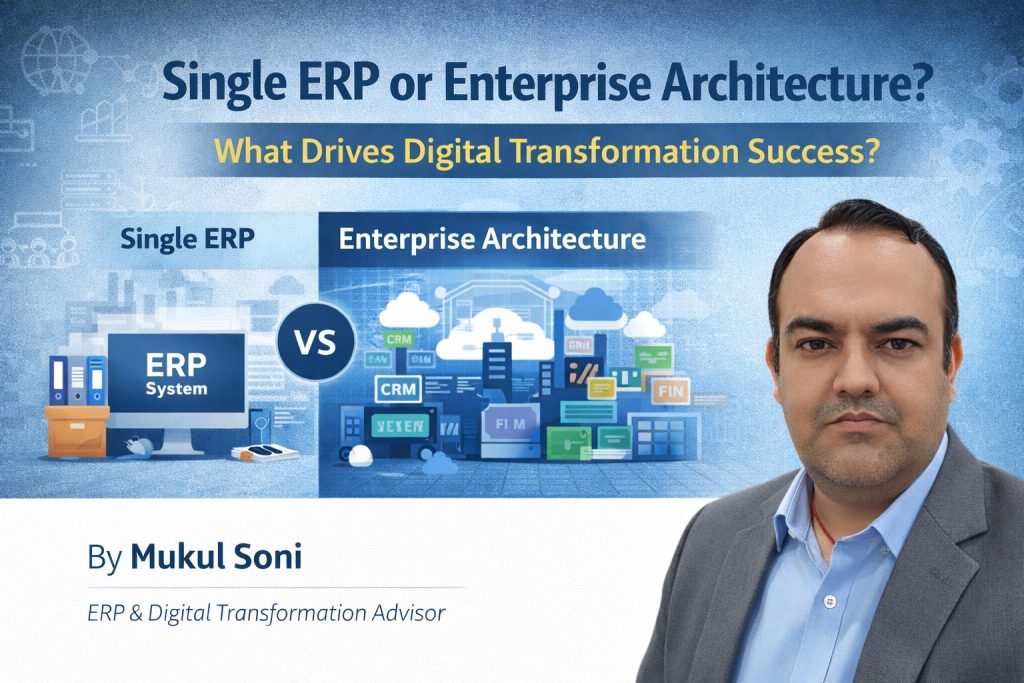
👉 ERP is just one component of this larger design.
🔗 ERP as Part of a Technology Ecosystem
In modern digital transformation, ERP systems operate within a broader ecosystem:
- One system may handle financial governance and compliance
- Another may manage enterprise transactions
- Specialized platforms support manufacturing, supply chain, or CRM
- Integration layers connect systems and ensure data flow
This approach creates:
✅ Flexibility
✅ Scalability
✅ Better alignment with business needs
🏭 Real-World Perspective from Transformation Programs
In large-scale transformation programs, especially in multi-entity environments, success rarely depends on choosing the “best ERP.”
Instead, success depends on:
- Designing the right enterprise operating model
- Aligning processes across business units
- Establishing strong governance frameworks
- Ensuring seamless integration between systems
Without this foundation, even the most advanced ERP systems struggle to deliver value.
🚀 Why Enterprise Architecture Drives Competitive Advantage
Organizations that adopt an architecture-first approach gain:
✅ Agility
Ability to adapt systems based on business needs
✅ Scalability
Support for growth across regions and entities
✅ Visibility
Integrated data across the enterprise
✅ Governance
Control and consistency in decision-making
🔑 ERP vs Enterprise Architecture: Key Insight
ERP remains a critical backbone of enterprise systems.
However:
👉 Competitive advantage does not come from the ERP itself
👉 It comes from how organizations orchestrate systems, processes, and data
🎯 Key Takeaways
- A single ERP cannot handle modern enterprise complexity
- Enterprise architecture should drive transformation decisions
- ERP should be part of a broader digital ecosystem
- Process alignment and governance are critical
- Integration across systems defines success
📩 Conclusion
The real starting point of digital transformation is not ERP selection.
It is business architecture.
Organizations that design their enterprise architecture first—and then align ERP within that structure—are far more likely to achieve scalable and sustainable success.
📞 Call to Action
If your organization is:
- Evaluating ERP systems
- Managing multi-entity complexity
- Planning digital transformation
👉 B2Grow can help you design the right enterprise architecture and ERP strategy.
📩 Connect with us to build scalable, future-ready systems.