Executive Summary
Organizations invest heavily in growth initiatives, digital transformation, operational expansion, and new technologies. Yet many continue to face margin pressure, execution challenges, and operational inefficiencies.
The underlying issue is often not a lack of growth.
It is value leakage.
Value leakage occurs when organizations lose potential value through governance gaps, stakeholder misalignment, operational waste, inefficient resource utilization, and poor execution discipline.
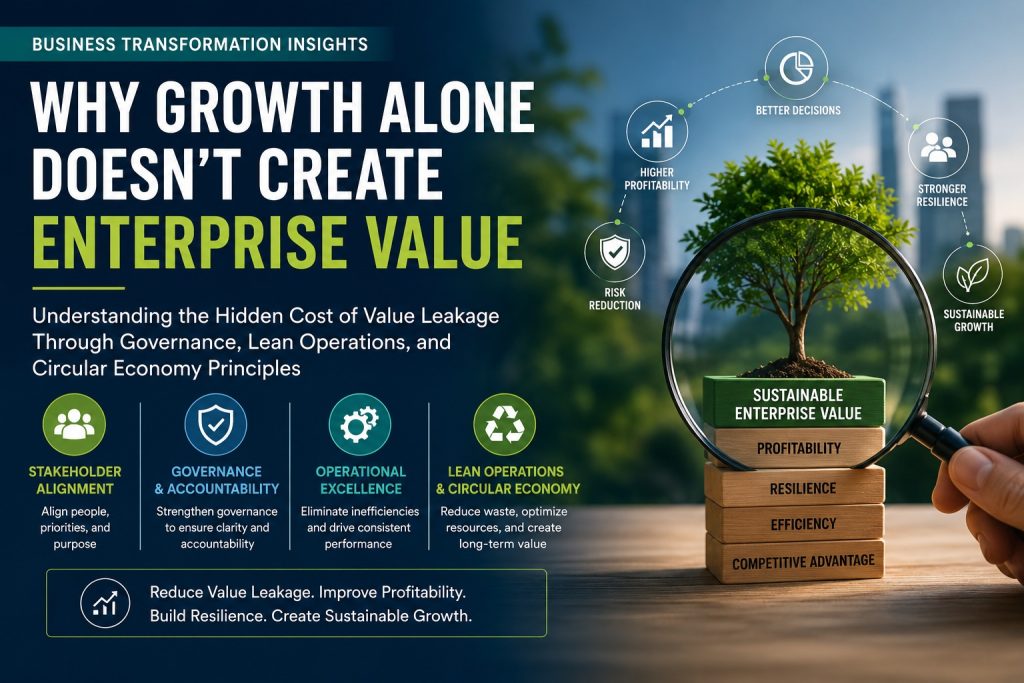
This article explores the major sources of value leakage and how governance, lean operations, circular economy principles, and disciplined execution can help organizations improve profitability, resilience, and long-term enterprise value.
Growth Is Not the Same as Value Creation
Organizations enter new markets, launch new products, expand operations, implement technology platforms, and pursue ambitious transformation initiatives with the expectation of creating greater enterprise value.
Yet many organizations experience a surprising reality.
Revenue grows.
Operations become more complex.
Technology investments increase.
But profitability, efficiency, and execution do not improve at the same pace.
The challenge is often not a lack of growth.
It is value leakage.
Value leakage quietly erodes profitability, operational performance, and enterprise value through inefficiencies, stakeholder misalignment, governance gaps, resource waste, and execution challenges.
While growth receives attention, value leakage frequently remains hidden beneath daily operations.
Organizations that consistently outperform their peers are not always those that grow the fastest. They are often the ones that systematically identify, measure, and eliminate value leakage before it becomes a strategic risk.
Understanding Value Leakage
Value leakage refers to the loss of potential value due to inefficiencies, poor governance, operational waste, stakeholder misalignment, or ineffective execution.
Unlike visible business challenges, value leakage often remains hidden within daily operations.
It appears in many forms:
- Margin erosion
- Delayed decision-making
- Operational inefficiencies
- Resource underutilization
- Inventory waste
- Supply chain disruptions
- Poor accountability
- Misaligned priorities
- Project overruns
- Quality issues
- Lost productivity
Individually, these issues may appear manageable.
Collectively, they can significantly reduce profitability and organizational effectiveness.
For many organizations, the fastest path to improving financial performance is not increasing revenue.
It is eliminating the value that is already being lost.
Why Value Leakage Often Goes Unnoticed
Unlike declining sales or customer complaints, value leakage rarely appears as a single visible problem.
Instead, it accumulates gradually across departments, processes, projects, and decision-making structures.
Common warning signs include:
- Rising operational costs despite revenue growth
- Delays in strategic initiatives
- Frequent firefighting by leadership teams
- Inventory imbalances
- Margin pressure
- Rework and quality issues
- Lack of accountability
- Multiple versions of operational data
- Slow decision-making
Many organizations address these symptoms independently.
In reality, they are often interconnected and stem from the same underlying issues.
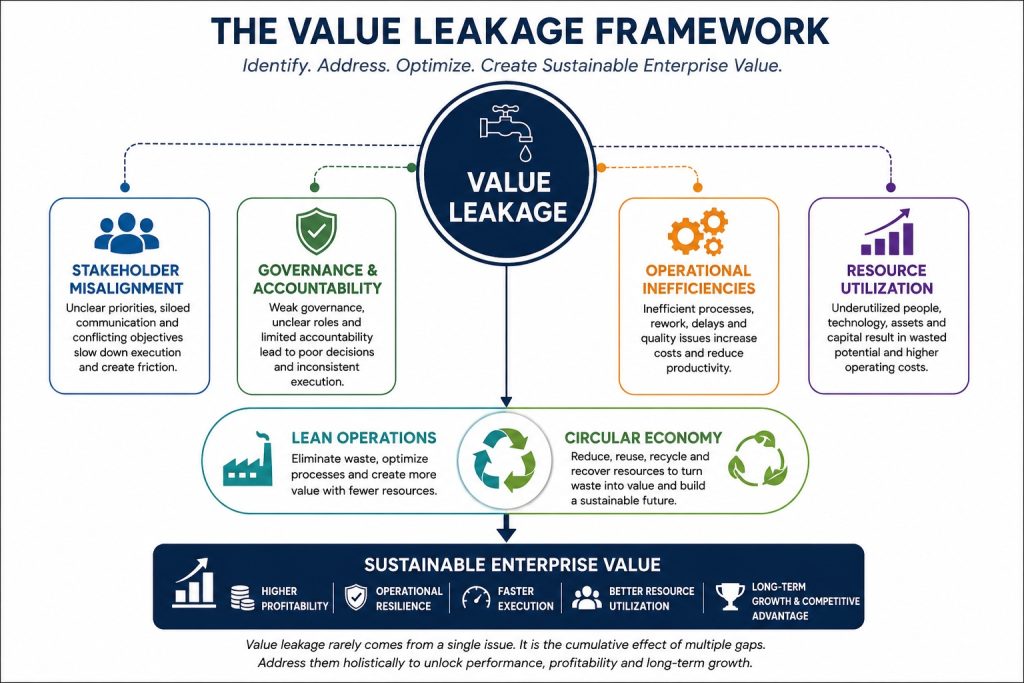
Four Major Sources of Value Leakage
1. Stakeholder Misalignment
As organizations grow, decision-making becomes increasingly complex.
Leadership teams may agree on strategic goals but differ on priorities, execution approaches, resource allocation, and success metrics.
The consequences are significant:
- Slower execution
- Internal conflicts
- Duplicated efforts
- Delayed decisions
- Reduced accountability
- Weak transformation outcomes
Many transformation initiatives struggle not because of technology limitations, but because stakeholders never achieve true alignment.
Successful transformation begins with people, not systems.
2. Margin Leakage and Financial Inefficiencies
Revenue growth does not automatically translate into profitability.
Many organizations unknowingly lose significant value through:
- Uncontrolled discounting
- Procurement inefficiencies
- Contract management gaps
- Excess inventory
- Rework and quality failures
- Poor cost visibility
- Inefficient resource allocation
Organizations that focus on margin protection frequently discover opportunities that create more value than acquiring additional customers.
3. Supply Chain and Operational Risk
Supply chain disruptions, vendor dependency, inventory inaccuracies, and process bottlenecks can create substantial value leakage.
Common symptoms include:
- Delivery delays
- Excess inventory
- Stock shortages
- Increased operating costs
- Reduced customer satisfaction
- Working capital pressure
Operational resilience has become a strategic capability rather than an operational requirement.
4. Resource Utilization and Execution Gaps
Most organizations possess sufficient resources to achieve stronger outcomes.
The challenge is often execution.
Without governance, visibility, and accountability, resources become fragmented and underutilized.
The result includes:
- Missed deadlines
- Budget overruns
- Lower productivity
- Employee frustration
- Transformation fatigue
Execution discipline remains one of the most valuable competitive advantages in modern business.
Lean Manufacturing: Eliminating Waste Before It Becomes Cost
Lean Manufacturing is often viewed as a production methodology.
In reality, it is a business philosophy focused on maximizing value while minimizing waste.
Its principles extend beyond manufacturing and can be applied across procurement, logistics, administration, project management, and service delivery.
Common forms of waste include:
- Overproduction
- Waiting time
- Excess inventory
- Unnecessary movement
- Transportation inefficiencies
- Rework and defects
- Underutilized talent
Organizations that embrace lean principles often achieve:
- Higher productivity
- Lower operating costs
- Faster response times
- Improved quality
- Better customer satisfaction
- Stronger profitability
Lean thinking helps organizations reduce value leakage before it becomes a financial problem.
Circular Economy: Turning Waste into Competitive Advantage
Many organizations still view sustainability primarily through a compliance lens.
However, leading organizations increasingly recognize that circular economy principles can create measurable business value.
Traditional business models follow a linear approach:
Take → Make → Use → Dispose
The Circular Economy introduces a different model:
Reduce → Reuse → Recycle → Recover
Instead of viewing waste as an unavoidable cost, organizations view it as a resource that can be recovered, optimized, and reused.
Examples include:
- Recovering production waste
- Reusing materials
- Extending product life cycles
- Optimizing energy consumption
- Reducing raw material dependency
- Developing recycling ecosystems
Lean Manufacturing focuses on eliminating waste from processes.
Circular Economy extends the same philosophy to materials, resources, and energy.
Together, they help organizations reduce value leakage across the entire value chain.
Lessons from Large-Scale Transformation Programs
Across complex transformation initiatives involving multiple stakeholders, technologies, and operating environments, a consistent pattern frequently emerges.
Organizations rarely struggle because of a lack of technology.
More often, challenges arise from unclear governance, fragmented decision-making, competing priorities, and limited accountability.
Technology improves visibility.
Processes improve consistency.
But sustainable transformation occurs when leadership alignment, governance structures, and execution discipline work together.
Organizations that address these elements early typically achieve faster adoption, stronger outcomes, and more sustainable results.
Why Technology Alone Cannot Solve Value Leakage
ERP systems, AI platforms, analytics tools, and digital transformation programs can significantly improve business capabilities.
However, technology alone does not create transformation.
An ERP system can provide visibility.
It cannot create accountability.
A dashboard can identify performance issues.
It cannot align leadership teams.
Artificial intelligence can accelerate decisions.
It cannot replace governance and leadership.
Technology amplifies organizational capabilities.
It does not replace them.
The VALUE Framework
Organizations seeking to reduce value leakage can adopt the VALUE Framework:
V – Visibility
Create transparency across operations, financials, and performance metrics.
A – Accountability
Assign clear ownership for initiatives, decisions, and outcomes.
L – Leadership Alignment
Ensure strategic objectives are understood across stakeholders.
U – Utilization
Optimize the use of people, technology, capital, and resources.
E – Execution Discipline
Establish governance structures that ensure consistent delivery and measurable outcomes.
Three Questions Every Leader Should Ask
- Where is value leaking across our organization today?
- Which operational inefficiencies are being hidden by revenue growth?
- Do our governance structures support execution, accountability, and continuous improvement?
If leadership teams cannot confidently answer these questions, value leakage is likely already occurring.
Final Thoughts
Many organizations focus significant attention on finding new opportunities for growth.
Yet some of the greatest opportunities already exist within their own operations.
Value leakage is rarely caused by a single issue.
It is often the cumulative effect of governance gaps, operational inefficiencies, stakeholder misalignment, resource waste, and inconsistent execution.
Organizations that successfully address these challenges gain more than cost savings.
They improve agility.
They strengthen resilience.
They enhance profitability.
And they create a stronger foundation for sustainable growth.
Growth creates opportunity.
Operational excellence creates performance.
Governance protects value.
Organizations that master all three will be best positioned to create sustainable enterprise value in the years ahead.