Introduction
Many small and mid-sized retail businesses assume that growth challenges are driven by lack of demand.
However, in reality, the issue often lies deeper—in how inventory and working capital are structured.
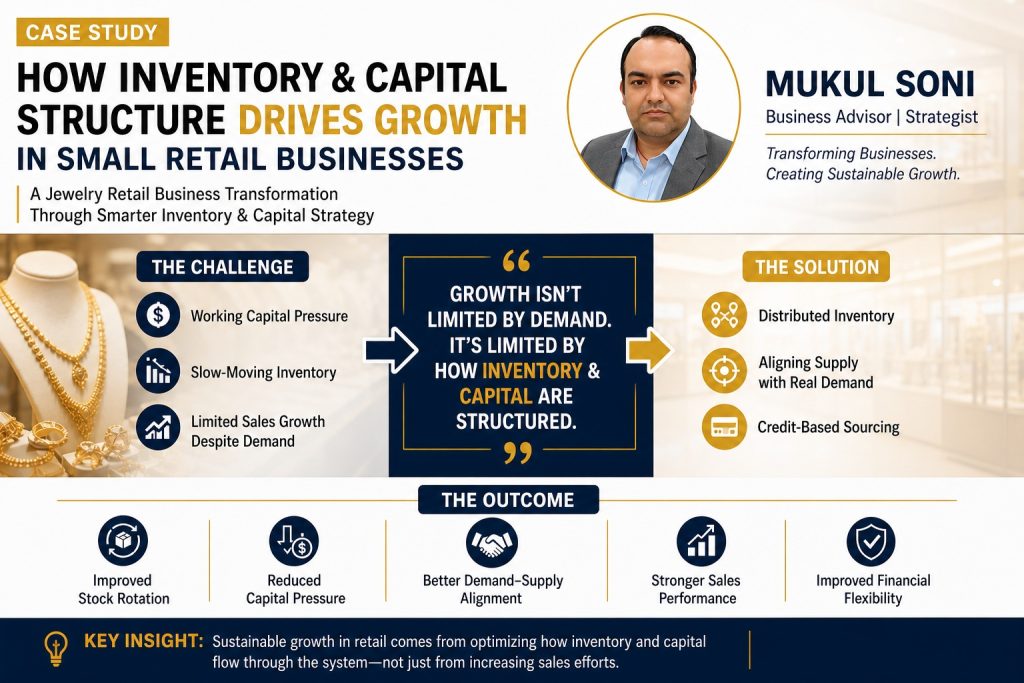
This case explores how a jewelry retail business, generating under $1M in annual revenue, improved performance not by increasing demand, but by restructuring its inventory and capital flow.
Business Context
The business was experiencing:
- Working capital pressure
- Slow-moving inventory
- Limited sales growth despite demand
- High inventory holding costs
- Poor visibility into operations
At first glance, the problem seemed like weak market demand.
But a deeper analysis revealed a structural issue.
The Real Problem: Inventory and Capital Flow Misalignment
The core challenge was not demand—it was how inventory and capital were flowing through the system.
Key issues included:
- Capital locked in unsold stock
- No structured demand planning
- Inefficient inventory distribution
- Lack of alignment between sales and supply
This created a cycle of low stock movement and increasing financial pressure.
Common Mistake in Retail Businesses
In such situations, many businesses try to:
- Increase marketing spend
- Add more inventory
- Expand product variety
However, without fixing the underlying structure, these actions often increase capital pressure and worsen inefficiencies.
The Approach: Restructuring Inventory and Capital
A structured transformation was implemented across four key areas:
1. Distributed Inventory Model
Instead of holding all stock centrally, inventory was distributed using nearby shopkeepers as micro-warehouses.
👉 Benefits:
- Reduced upfront inventory investment
- Faster response to demand
- Improved stock movement
2. Working Capital Optimization
A credit-based sourcing model was introduced to reduce immediate cash outflow.
👉 Benefits:
- Lower capital pressure
- Improved cash flow
- Better purchasing flexibility
3. Demand-Aligned Supply
Inventory decisions were aligned with real demand patterns instead of assumptions.
👉 Benefits:
- Reduced dead stock
- Better product mix
- Higher sales conversion
4. Technology Enablement
Inventory tracking and business management systems were introduced to improve visibility and control.
👉 Benefits:
- Better decision-making
- Improved operational transparency
Results and Business Impact
The restructuring delivered measurable improvements:
- Improved stock rotation
- Reduced working capital pressure
- Better alignment between supply and demand
- Increased sales performance
- Improved financial flexibility
Key Insight
The business was not constrained by demand—but by how inventory, capital, and operations were structured.
Growth does not always require more demand.
It requires better structure behind it.
Conclusion
For retail businesses, sustainable growth comes from optimizing how inventory and capital flow through the system—not just increasing sales efforts.
Organizations that focus on structure gain:
- Better control
- Improved efficiency
- Stronger long-term performance