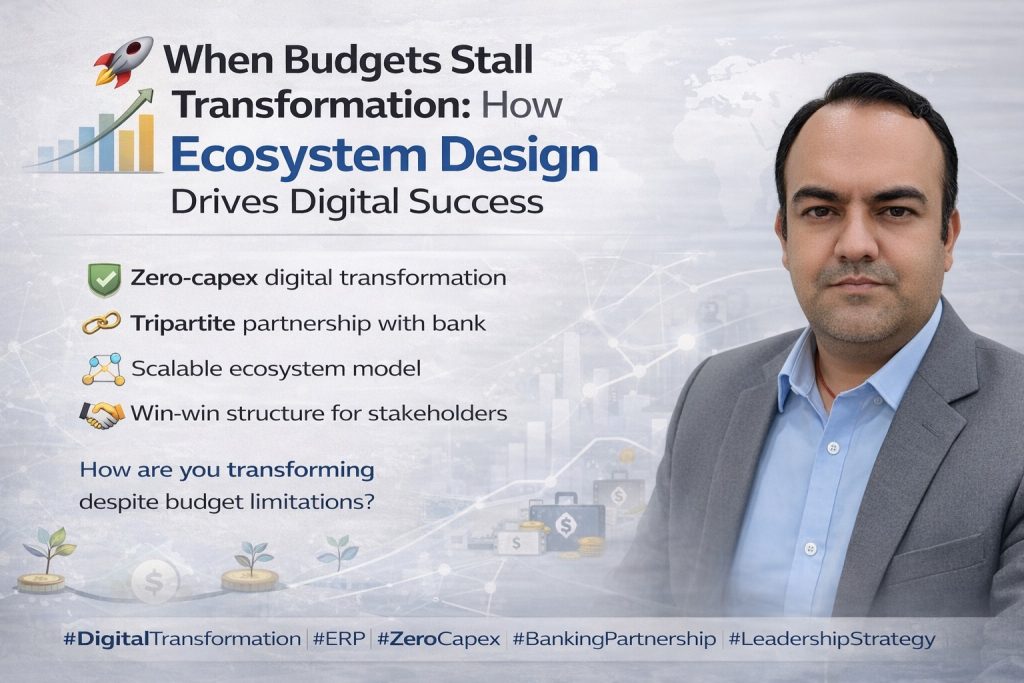
📌 Introduction
In many large-scale digital transformation programs, the biggest constraint is not technology—
👉 it is budget.
Organizations recognize the need for modernization.
They understand the risks of manual operations.
Yet, transformation often gets delayed due to capital constraints.
So the question becomes:
👉 How do you drive transformation when traditional ERP investment is not feasible?
The answer lies in ecosystem design.
⚠️ The Challenge: Scale Without Digital Infrastructure
In one engagement, the organization was serving millions of customers, yet core operations remained largely manual.
The business impact was significant:
- Revenue leakage across transactions
- Delays in reconciliation and reporting
- Operational inefficiencies at scale
- Rising customer dissatisfaction
- Limited ability to generate employment
Leadership clearly recognized the need for transformation.
However, budget constraints stalled progress.
🎯 The Strategic Shift: From ERP Implementation to Ecosystem Thinking
Instead of pushing a traditional ERP implementation, the problem was reframed:
👉 Not as a system upgrade
👉 But as an ecosystem transformation opportunity
⚙️ The Solution: Designing a Digital Ecosystem
An end-to-end digital platform was conceptualized to:
✔ Plug revenue leakage
✔ Improve customer experience and accessibility
✔ Enable real-time operational visibility
✔ Create employment opportunities within the ecosystem
✔ Strengthen governance and resilience
The solution was strategically sound.
But one challenge remained—
👉 funding
💡 The Breakthrough: Tripartite Partnership Model
This is where leadership thinking made the difference.
A tripartite ecosystem model was designed:
🔹 Key Structure
- A banking partner invested in the platform
- The bank gained transaction volume and new customers
- The client received the solution with zero upfront investment
- Customers could transact via digital and assisted channels
📊 Financial Viability
The model demonstrated:
👉 The banking partner could achieve full ROI within ~2 years
This alignment of incentives created a win-win structure across stakeholders.
🚀 The Outcome
Once stakeholders aligned, the program moved forward successfully.
✔ Key Results
- Zero-capex digital transformation rollout
- New employment opportunities created
- High-volume customer funnel activated
- Faster and more reliable service delivery
- Scalable platform for long-term growth
🧠 Key Insight
Transformation at scale is not always about deploying systems.
It is about designing ecosystems where every stakeholder benefits.
🔑 Why This Matters for Leaders
This approach highlights a critical shift in modern transformation strategy:
| Traditional Approach | Ecosystem Approach |
|---|---|
| Capex-driven ERP | Partnership-driven model |
| Internal optimization | Multi-stakeholder value creation |
| Budget-dependent | ROI-aligned investment |
| Slow execution | Accelerated transformation |
🚀 Conclusion
Budget constraints often delay transformation—
but they don’t have to stop it.
With the right approach, organizations can:
👉 Shift from investment-heavy models
👉 To ecosystem-driven transformation strategies
❓ Final Thought
If budget is the constraint—
are you trying to solve the problem internally…
or redesigning the ecosystem around it?
📩 Call to Action
If you’re exploring zero-capex digital transformation models or ecosystem-driven platforms, let’s connect.