🔍 Introduction
Many organizations invest heavily in ERP systems expecting seamless operations, real-time visibility, and better decision-making.
Yet, even after go-live, a common challenge persists:
👉 Teams continue to rely on spreadsheets
👉 Critical reports are maintained outside the system
👉 Decision-making happens in Excel instead of ERP
This raises a key question:
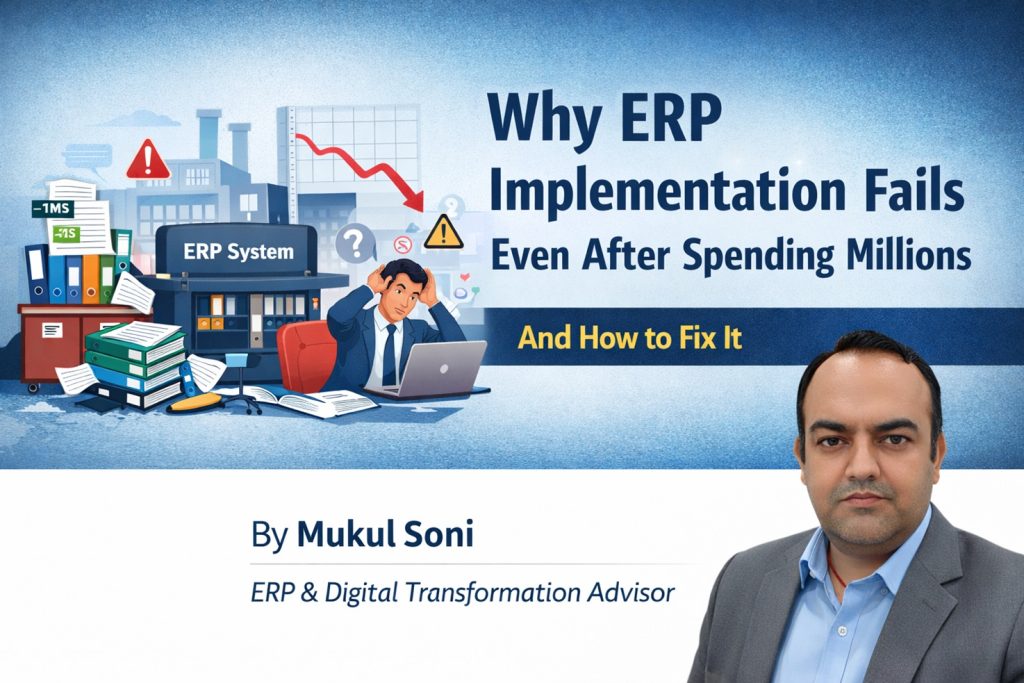
Why does ERP implementation fail even after significant investment?
⚠️ The Real Reason Behind ERP Implementation Failure
ERP implementation failure is rarely about the software.
The real issue lies in how organizations approach transformation.
Most companies treat ERP as a technology project, whereas it is actually a business transformation initiative.
ERP systems are designed to bring:
- Standardized processes
- Integrated data flows
- Real-time reporting
However, without proper alignment in process ownership, governance, and data discipline, the system cannot deliver its intended value.
📊 ERP vs Excel: Why Businesses Still Depend on Spreadsheets
One of the biggest indicators of ERP failure is Excel dependency.
Even after ERP implementation:
- Finance teams reconcile data in Excel
- Operations manage production outside the system
- Management relies on multiple reports
This is not a technology failure.
👉 It is a process and governance failure
When ERP data is not trusted, users naturally fall back to Excel.
Over time, Excel becomes the real operating system, while ERP remains underutilized.
🏭 Multi-Entity ERP Challenges
In large organizations, especially those operating across multiple entities, ERP complexity increases significantly.
From my experience in transformation programs, multi-entity ERP environments face challenges such as:
- Different business processes across units
- Independent reporting structures
- Lack of standardized governance
Without alignment, ERP systems become fragmented.
Instead of creating a unified platform, they replicate organizational silos.
🧠 ERP Governance: The Missing Link
Strong ERP governance is critical for success.
Organizations must define:
✅ Process Ownership
- Who owns each business process?
- How are decisions made across departments?
✅ Data Discipline
- What defines correct data?
- How is data validated?
✅ Governance Framework
- How are controls enforced?
- How is consistency maintained?
Without these, ERP systems cannot function as a single source of truth.
🚀 How to Fix ERP Implementation Failure
To avoid ERP failure and ensure success:
1. Align Processes Before Implementation
Do not automate broken processes. Fix them first.
2. Establish Strong Governance
Define ownership, accountability, and decision-making frameworks.
3. Build Data Discipline
Ensure data accuracy from day one.
4. Focus on Adoption, Not Just Go-Live
ERP success is measured by usage, not deployment.
5. Design for Multi-Entity Alignment
Create a unified operating model across business units.
🎯 ERP as a Digital Backbone
ERP should not be treated as just another IT system.
It should act as:
- A single source of truth
- A decision-making platform
- A foundation for digital transformation
When governance, processes, and data are aligned, ERP becomes a true business enabler.
🔑 Key Takeaways
- ERP implementation failure is rarely about technology
- Excel dependency signals deeper process issues
- Multi-entity ERP requires strong alignment
- Governance and ownership drive success
- ERP must be treated as a business transformation initiative
📩 Conclusion
ERP systems do not fail because of software.
They fail when organizations underestimate process alignment, governance, and data discipline.
When done right, ERP evolves from a transactional tool into a strategic decision platform.
📞 Call to Action
If your organization is facing:
- ERP vs Excel challenges
- Multi-entity ERP complexity
- Lack of ERP governance
👉 B2Grow can help you design the right digital architecture and transformation roadmap.
📩 Connect with us to explore how your ERP can deliver real business value.